Sunday, February 28, 2010


Sunday, February 14, 2010
Woodpecker lunch

 Woodpecker eating suet
This Hairy Woodpecker is enjoying lunch in spite of having it's picture taken. As usual, it has to share the bounty with other birds but probably knows there is more where that came from. The birds are so used to people interrupting their meals or if someone tries to touch them that they will only fly up in the closest tree until we move away.
Sunday, February 7, 2010
Tracks
We now have a lovely pattern in the snow on the lawn. It appears that a friendly fox or two were around to visit. We nor our neighbors have dogs so we know they are not dog tracks. We have seen foxes around and we do have wild rabbits so maybe they were having a game of tag.


Saturday, January 30, 2010
Freeze Frame!

 Not quite as chilly as it was when I got up this morning but still a bit on the crisp side. Even at this temperature, the birds are happily feeding away at the seed and suet feeders. It amazes me that with the earth frozen, the house creaking with cold, the trees snapping with frost and those little birds just carry on doing what they do every day of the year. Eat, sleep and try to stay comfortable in their living quarters while we try to do the same. Like the birds, some people like the cold, some fly south and some like to do a little of both. What kind are you? Comments and feedback are welcome.
Sunday, January 24, 2010
Shrike?

I am almost certain this is a Northern Shrike. It has been many years since I have seen one here but this one has been feeding on a mouse and has ignored the seed feeders. It has been here for about a week now and as we have a lot of chickadees and goldfinches as well as mice and moles, perhaps this one will join the owl and stay around. If anyone thinks it might be something different - please let me know.
Sunday, January 3, 2010
OWLS
This beauty is a barred owl and it is waiting patiently for a mouse to come along. One of our feeders is close to the ground and as usual, the birds tend to leave a few bits on the ground at the end of the day. The mice come along to eat the leftover seeds and the owl waits patiently for his dinner. In the past we have seen many barred owls and one very small screech owl here.

Over the years these barred owls have come around mostly during the winter months, but occasionally in other seasons as well. One of them was sitting on a branch in the hemlock tree beside the house and appeared to be watching us in the house. The next morning I assumed that it had flown away. In the afternoon my daughter was coming home from school and asked why the owl was sleeping in the snow under the tree. I took it to a bird expert who informed me that owls often starve to death during the winter from lack of food. I think that is one of the reasons, all these years later, that I feed all the birds especially during the harsh winter months. Other than attracting the mice for them, I have not discovered another method for feeding the owls.
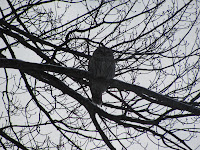 This update is a daytime picture of the barred owl in a oak tree. He should be sleeping!
SCIENTIFIC NAME Strix varia
CLASSIFICATION

Over the years these barred owls have come around mostly during the winter months, but occasionally in other seasons as well. One of them was sitting on a branch in the hemlock tree beside the house and appeared to be watching us in the house. The next morning I assumed that it had flown away. In the afternoon my daughter was coming home from school and asked why the owl was sleeping in the snow under the tree. I took it to a bird expert who informed me that owls often starve to death during the winter from lack of food. I think that is one of the reasons, all these years later, that I feed all the birds especially during the harsh winter months. Other than attracting the mice for them, I have not discovered another method for feeding the owls.

SCIENTIFIC NAME Strix varia
CLASSIFICATION
SIZE
Class: Aves Order: Strigiformes Family: Strigidae Genus: Strix Species: varia
APPEARANCE: The Barred Owl is a medium-sized gray-brown owl that is streaked with white horizontal barring on the chest and vertical barring on the belly. They are round-headed with a whitish-brown facial disk that has brown trim. There are no feather tufts. The eyes are brown, and the beak is yellow and almost covered by feathers. The dark brown back is spotted with white and the long tail is crossed with six or seven sharply defined bands of pale brown. There is no difference in plumage between the males and the larger females.
Length: Male: 17-20 inches Female: 20-24 inches Weight: Male: 1-1 1/2 pounds Female: 1 1/2-1 3/4 pounds Wingspan: Male: 40-46 inches Female: 45-50 inches
Thursday, December 24, 2009
We have had snow and colder weather for a while and finally the bears, raccoons and chipmunks have gone into hibernation for the winter. I can finally leave my bird feeders out just for the birds. They are making such good use of them that I just can't seem to keep ahead of them. Sunflowers, suet, nuts and just balls of fat seem to keep them coming back. My favourite hummingbirds however have flown south for a bit. Nothing like rushing the seasons but I can't wait to see the first ones coming to my window and hovering there as if to say - what - no food out for me yet? It seems every year one in particular comes to the window and, as if suspended from a string, will stare at me through the window.
Subscribe to:
Posts (Atom)